
“I walk along the avenue, I never thought I’d meet a girl like you
Meet a girl like you, With auburn hair and tawny eyes
The kind of eyes that hypnotise me through, Hypnotise me through
And I ran, I ran so far away
I just ran, I ran all night and day” – I ran, A Flock Of Seagulls
Tale as old as time
The Mesopotamian civilization of Assyria developed from the city state of Assur in the Bronze Age to an empire that lasted throughout the Iron Age. The empire peaked and then ultimately collapsed in the Neo-Assyrian period, defeated by a coalition of the subject Babylonians and Medians, in 758 BC.
Various Median tribes united under the leadership of Deioces, the autocratic first king of Medes, who ruled from 694-665 BC from his base at the new kingdom’s first capital, Ecbatana.
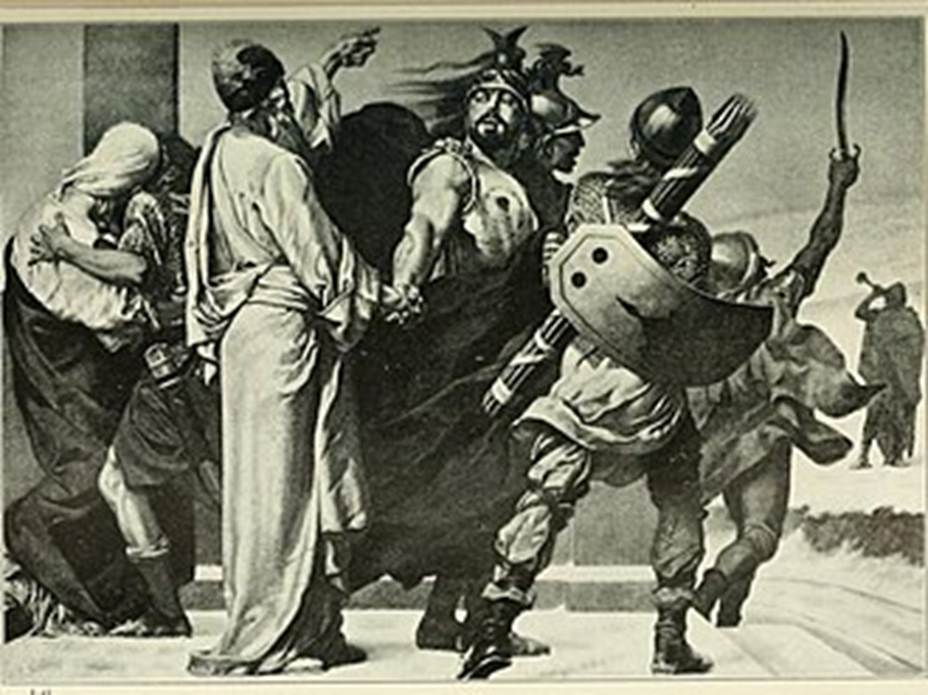
Deioces commands the Medes to set forth on their course of conquest – Louis Boulanger
Although the Median kingdom lasted only a little over 200 years before it was conquered by the rival Achaemenid Empire, in 550 BC, its founding and subsequent emergence as a major player in the Mesopotamian region, is seen as a key event in the timeline which, according to Hegel and others, places Iran as the world’s oldest, most continuously enduring sovereign nation. That claim, whether or not it was in fact the very first or one of the first, means that all modern nation states are, to some extent derivations from this model. In a sense, the modern American state can trace a line of heredity back to ancient Media.
A Great time
Founded by Cyrus the Great in 550 BC, the Achaemenid Empire’s unprecedented conquests created, relatively quickly, the largest empire of the time, ranging from the Balkans and Europe in the west to the Indus Valley and Asian in the east, and northern Africa in the south. Despite its broad record of martial success, the Achaemenid Empire is perhaps remembered best militarily for its attritional and ultimately unsuccessful attempts to expand into Greece (with Xerxes’ famous victory at Thermopylae more than offset by Darius’ defeat at Marathon and Xerxes’ defeats at Salamis and Plataea) and by even more crushing defeat at the hands of Alexander The Great of Macedon. After the death of Alexander and the collapse of the Empire that he had built during his relatively brief life and career, an autonomous Kingdom ultimately re-emerged in the region, after the intermission of the relatively brief empire established by Alexander’s general, Seleucus I Nicator.
The resulting two dynasties, known today as the Parthian Empire and the Sasanian Empire were in turn the most persistent adversary of ancient Rome and of Byzantium (later named Constantinople after Constantine The Great) and ultimately survived almost 900 years, lasting until 651 AD. During this time, parts of the empires were occupied periodically by Rome, but was never permanently conquered.
Who’s zooming whom?
Following the rise of Islam in the region, the Sasanian Empire fell to the early Muslim conquests, initiated by Muhammad and continued by the Rashidun Caliphate (and later to Mongol invasion).
Following the early Islamic schisms, and after over eight centuries of subjugation to foreign powers, Iran eventually became the main centre of the Shia faith. The persistence of local culture, which ultimately survived and in many ways triumphed over foreign occupation gave rise to the aphorism that
“conquered Persia takes captive her conquerors”.[1]
While the countries’ adversaries may have been victorious in battle, and even imposed occupations that lasted for multiple centuries, the strength of its cultures is claimed to have triumphed over and ultimately absorbed the culture of its occupiers. In other words, any country that achieves military victory over Iran, will still find its own culture overtaken by purportedly superior Persian culture.[2]
The Empires strike
By the 16th century Iran re-emerged as a leading global power. Its main rival continued to be Constantinople, which had by this time of course evolved into the centre of the Ottoman Empire, Istanbul.
In the 19th century, Iran was largely treated as a strategically-located prize over which the British and Russian empires fought.[3] Defeat to the Russian Empire resulted in the loss of the South Caucasus.
One of the major acts by the declining British Empire amidst the regional turmoil following WW1, was the subversion of the ruling Qajar dynasty. Groomed by the British, Reza Khan Pahlavi, an Iranian army officer, was declared Shah of Iran on 12 December 1925. Pahlavi reportedly planned to declare an Iranian Republic, in the way that Mustafa Kemal Atatürk had replaced the Ottoman Sultanate in Turkey a couple of years earlier until he was seemingly prevented from doing so by British opposition, who installed the Pahlavi dynasty as rulers of Iran as an autocratic monarchy, with its founding member referred to as Reza Shah Pahlavi. One of the first challenges facing Reza Shah Pahlavi was the renegotiation of terms under which the previous regime had sold Iranian oil rights to the British.
For more information and to speak with our advisors, please contact us at info@mbmg-investment.com or call on +66 2 666 4878.
About the Author:
Paul Gambles is licensed by the SEC as both a Securities Fundamental Investment Analyst and an Investment Planner.
Disclaimers:
1. While every effort has been made to ensure that the information contained herein is correct, MBMG Investment Advisory cannot be held responsible for any errors that may occur. The views of the contributors may not necessarily reflect the house view of MBMG Investment Advisory. Views and opinions expressed herein may change with market conditions and should not be used in isolation.
2. Please ensure you understand the nature of the products, return conditions and risks before making any investment decision.
3. An investment is not a deposit; it carries investment risk. Investors are encouraged to make an investment only when investing in such an asset corresponds with their own objectives and only after they have acknowledged all risks and have been informed that the return may be more or less than the initial sum.
[1] Growing up in northern England in the 1960s, I recall stories told by my grandparents of a time when people wouldn’t lock the door when leaving their house. This myth of a happier time was somewhat shattered by the caveat that this was largely because nobody had anything worth stealing in those days and even if they did, locking the door wouldn’t have kept determined burglars out. In our family, there was also one other factor, Mick. Mick was a small black mongrel who had long realised that he lacked the strength and ferocity to keep potential invaders out of his domain. What he lacked in physical strength and intimidation, Mick more than made up for in cunning. Mick’s party piece was to allow strangers into the house but then, once they were in, he’d wrap himself tightly around their ankles to prevent them leaving. In the case of one unfortunate postman new to the patch, this lasted for several hours until a family member returned home and freed Mick’s hostage. Conquered Mick certainly too captive his conquerors.
[2] The terms Iran and Persia are often used interchangeably but Iran, which is often mis-pronounced in American media –
But Iran (the land of the Aryan people) is the indigenous terminology. Persia comes from the Greek rending of Parsa, the part of southwestern Iranian from which the founders of the early Persian Empire that rivalled the Greek city states, hailed. To that extent, Persian is essentially a sub-set of the Iranian people. This is reflected in the inscription of Darius The Great, which stated: “I am Darius, the Great King… an Achaemenid, a Persian, son of a Persian, an Aryan of Aryan lineage.” Today, we would be more likely to use the term Iranian than Aryan in general descriptions of people of the region.
[3] In 1892, George Curzon, the British Viceroy to India, famously described Iran as “pieces on a chessboard upon which is being played out a game for the dominion of the world.”
4 Comments
Comments are closed.