
Today’s world is highly systematic. In very few, if any fields, are actions are so unique or disconnected that they don’t form part of a broader, complex process. Our world is an agglomeration of constantly changing and inherently dynamic systems.
In complex systems (i.e., those with three or more variables), as Steve Keen has explained[1], the interaction between variables matters much more than the change in any single variable. This is a phenomenon invariably overlooked by mainstream economists.
“Economists worship ‘equilibrium’ – the myth that economies settle into balance. Irving Fisher (America’s ‘most influential economist’) finally admitted: ‘Assuming the economy stays in equilibrium is like assuming the Atlantic has no waves.’
Engineers understand the world better than economists. They know systems have feedback loops, time delays, and non-linear relationships that create booms, busts, and chaos. We need SYSTEM DYNAMICS… My advice? Study engineering, coding, or Systems Dynamic Modelling. Then apply it to economics.” — Prof. Steve Keen (Don’t study economics at university. –8th May, 2025)
The impulse to seek solutions predicated on equilibria reflects a flaw in human cognition. We use heuristics—mental shortcuts—to apply linear frames of reference to non-linear situations.
The Disconnect
This disconnect between theory (equilibrium) and reality (chaos) is painfully evident right now in a momentously eventful year. Just look at the timeline:
-
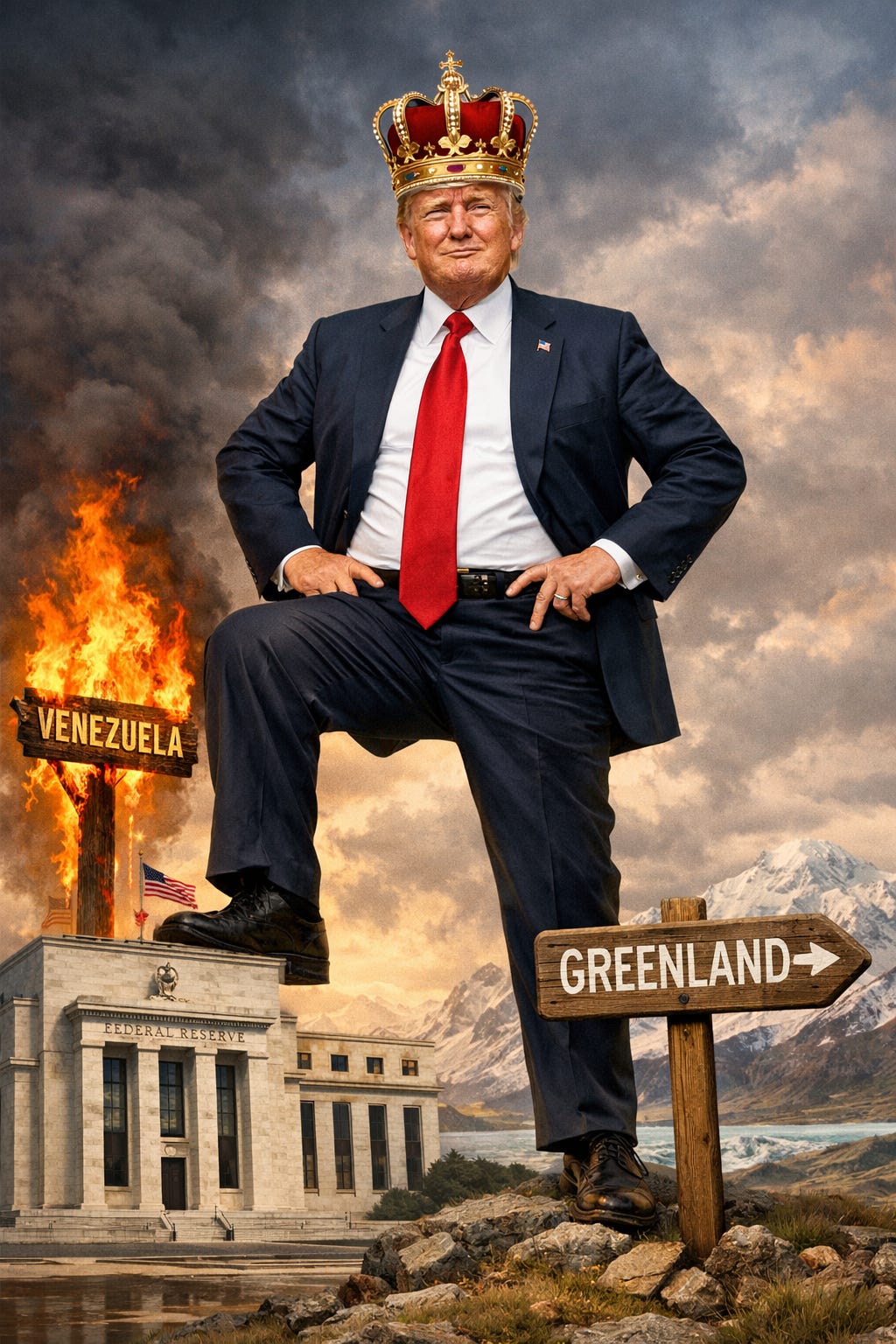
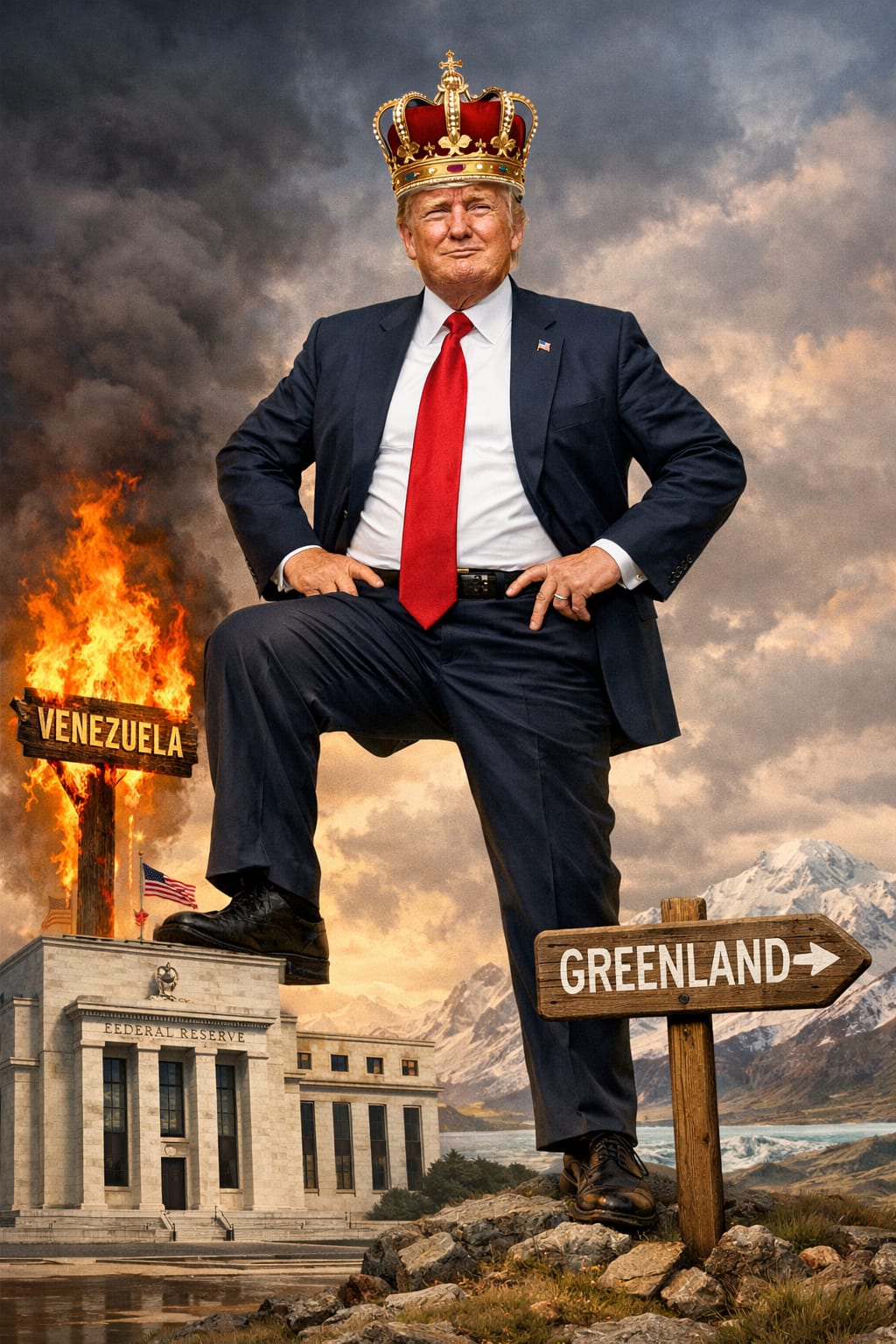
The “Donroe” Doctrine[2]: US military forces enacted a modern twist on the Monroe Doctrine by invading Venezuela to depose the elected government. It was a throwback to the overt approach of Teddy Roosevelt’s 19th-century ‘Rough Riders’—a stark contrast to the covert methods American policy has favoured for the last century.[3]
-
The Snub: Following the invasion, Trump snubbed María Corina Machado—the strongly pro-Trump (but unsuccessful) Venezuelan candidate—in favour of her fiercely anti-Trump rival. The rumour mills suggest this is purely because Senora Machado won the 2025 Nobel Peace Prize, an honour much coveted by Trump.
-
European Celebration: EU’s so-called leadership led sycophantic cheerleading of America’s latest military triumph, though Spain, Ireland, Hungary, Austria, Slovakia, and Slovenia condemned it, and Denmark expressed ‘concern.’
-
Code Brown: Less than a week later, Trump followed up by threatening to invade Greenland. Danish concern elevated to what might be called a full ‘Code Brown’.
-
The Pivot: Trump explained his invasion plans to a gathering of world leaders. The EU contingent present experienced a dramatic epiphany, suddenly aware of new downsides to US military footwear trampling other countries’ soil. Even Trump read the hostility in the room. The next day he declared that he never planned to invade Greenland, wondered how anyone had got that idea, and launched his ‘Board of Peace’.[4]
-
Starmer’s Almost Last Stand: Moving from the grub-crime to the ridiculous: The UK Government, in the death throes of Starmer’s political career[5], desperately chased the limelight by offering ‘boots on the ground’ to Ukraine.
-
Low Seas Piracy: Having failed to elicit the hoped-for response, Starmer decided to preserve the “rules-based international order” by engaging the Royal Navy in piracy against Russian or other merchant ships sailing in a “suspicious manner.”
-
The Limelight War: Although Starmer was ignored by everyone outside (and most inside) his own cabinet, Trump worried that the hapless Sir Keir might steal Don’s thunder. He reverted to US intelligence (an oxymoron?) type by destabilising Iran’s regime and threatening 25% additional sanctions on anyone who had ever been seen in Iran’s vicinity.
-
Domestic Chaos: Having created global chaos, Trump turned his sights on Minnesota (which he may have mistakenly presumed to be a foreign country). Agents of Immigration and Customs Enforcement (AKA ICE) exterminated two American nationals for the crime of being “legal non-immigrants.”[6]
-
The Final Target: Trump then turned his attention even closer to home, launching a criminal probe against the Federal Reserve and its officers.
Meanwhile in Thailand, most voters polled ahead of this weekend’s election either don’t want anyone to win or else want a candidate who almost certainly won’t be allowed to win.
The Bottom Line
It has been an extraordinary year.
And we still have eleven months remaining. Even by the standards of the Trump-Starmer-Merz-von der Leyen-Macron-Kallas world order, this is no ordinary time.
And yet, none of these events—not the invasions, the piracy, or the sanctions—moved markets nearly as much as Trump’s nomination for Fed Chairman.
Proof, if we needed it, that the worship of the false God of equilibrium is alive and well, despite the actual chaos that surrounds us.
For more information and to speak with our advisors, please contact us at info@mbmg-investment.com or call on +66 2 665 2534.
About the Author:
Paul Gambles is licensed by the SEC as both a Securities Fundamental Investment Analyst and an Investment Planner.
Disclaimers:
1. While every effort has been made to ensure that the information contained herein is correct, MBMG Investment Advisory cannot be held responsible for any errors that may occur. The views of the contributors may not necessarily reflect the house view of MBMG Investment Advisory. Views and opinions expressed herein may change with market conditions and should not be used in isolation.
2. Please ensure you understand the nature of the products, return conditions and risks before making any investment decision.
3. An investment is not a deposit, it carries investment risk. Investors are encouraged to make an investment only when investing in such an asset corresponds with their own objectives and only after they have acknowledged all risks and have been informed that the return may be more or less than the initial sum.
Footnoted
[1] Steve Keen has used the 3-body problem in physics as an analogy for dynamic economic systems. The three-body problem, which involves calculating the gravitationally influenced motion of three celestial bodies, is notoriously complex and incapable of solution by simple formulae as the resulting orbits involve chaotic, irregular or unpredictable motion.
[2] The doctrine, originated by President James Monroe in 1823, decreed that Europe’s turn was over and henceforth colonization and intervention in central or South America was entirely America’s prerogative.
[3] Since 1946, American agencies have been responsible for almost 100 attempted changes of regime – https://en.wikipedia.org/wiki/List_of_CIA_controversies
[4] It’s hard to describe Trump’s Board of Peace with a straight face – kudos to Bruce Jones for not trying- “Several world leaders showed up for a Trump-convened ‘peace summit’ in Sharm El-Sheikh to lend their diplomatic support. So imagine their surprise when, in January, they received their formal invitations to a wider Board of Peace, attaching terms of reference that appeared designed to replace the U.N. The text was stunning in its breadth and its absurdity: Trump himself would be the chair, both while president of the United States and afterward; Trump himself would have sole authority to accept members and decide on the body’s direction of action; members could buy a permanent seat for $1 billion, but Trump himself would control the funds. And he, and only he, could decide when the chair—himself—would step down, and who would replace him. Him, him, him. It was written in the word-salad-y language of formal institutions, purported to be the “mandate” of an international organization (minus pesky details like a treaty), and would come into force when—wait for it—three countries signed up. The Sunni Arab states collectively sidestepped the issue—they agreed to join the board but, in the language of their acquiescence statement, made clear that they were narrowly interpreting the board as germane only to the Gaza question as specified by the U.N. authorizing resolution. (“Yes, I’ll marry you; and by marry, I mean date; and by date, I mean maybe we’ll have coffee once a month.”) All of which culminated in a “signing ceremony” in Davos, minimally attended. Among the heavyweights in attendance were the presidents of Uzbekistan and Mongolia.” www.brookings.edu/articles/trumps-board-of-peace-and-the-multilateral-order/
[5] In this case ‘career’ is probably the intransitive verb meaning “to move uncontrollably”
[6] Alex Pretti and Renee Good were 2 of the 9 deaths at the hands of ICE in January.
1 Comment
Miles4840
https://shorturl.fm/zeb0h