
When a great man dies, for years the light he leaves behind him lies on the paths of men.” — Henry Wadsworth Longfellow
Mobius’ first degree wasn’t in economics, but in fine arts. He believes that studying art forces people to have an eye for detail and to really look beneath the surface.
“I think that’s helped me a lot. I also studied psychology and I think that’s been an enormous help to me – we all investors have psychological responses and reactions to events but recognising, understanding those is vitally important. It was only then that I studied economics.” – https://www.nationthailand.com/business/30212565
In memoriam – Doctor Mark Mobius
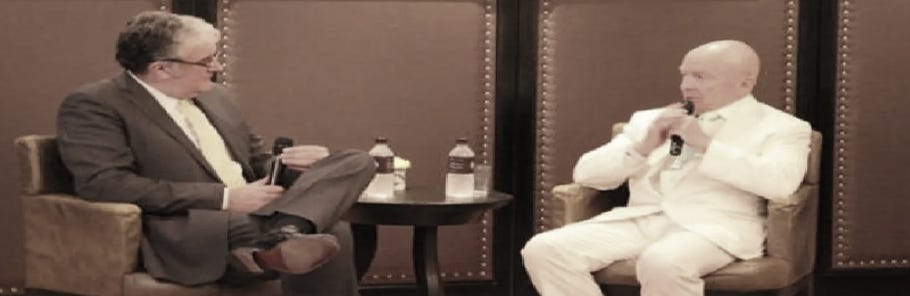
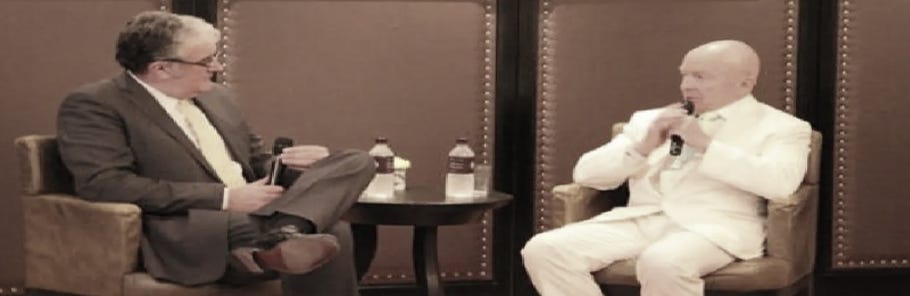
Mark Mobius was described in many ways during the course of his 89 years. Reports of his passing in April called him ‘The pioneering Indiana Jones of emerging markets’, noted his immaculate style and ‘dapper white suits’, and celebrated his impact on emerging-market investing. A globally admired investor but to me he was a friend and mentor.
Trailblazer
Long before Wall Street recognised the developing world’s potential, Mark Mobius saw opportunity in markets few considered uninvestable and most barely knew existed. Recruited by Sir John Templeton in 1987, he built the iconic Templeton Emerging Markets Group. Over three decades he travelled the globe, often telling me when he came to Thailand[1] that he visited malls to gauge people’s footfall, spending habits and mood. He realised that to grasp a market, you first had to understand its people.
He wasn’t one to shy away from turmoil; instead, he embraced it. Whether he was aggressively buying Asian equities after the 1997 financial crisis or investing in Africa and Eastern Europe when others panicked, Mark would often quote Sir John Templeton’s famous maxim, subsequently appropriated by Warren Buffett to be greedy when others are fearful and to be fearful when others are greedy.
A Blend of Warmth and Curiosity
Mark was the ultimate polymath – studying both Communications and Fine Arts before pivoting to Economics and Political Science; an accomplished concert pianist he loved recalling his student aspirations to tread the boards on Broadway before ending up as an investor. For those fortunate enough to call him a friend, Mark was so much more than his professional accolades. He brought his characteristic warmth, curiosity and sense of adventure to every aspect of life. He made the world feel a remarkably exciting place, living by a simple but powerful philosophy: “Nothing is impossible if you stop putting limits on yourself. I fundamentally believe that the world belongs to optimists.”
I was fortunate to be asked by Franklin Templeton to MC an event in Bangkok fourteen years ago celebrating Mark’s twenty-fifth anniversary with the firm. Two things stand out. First, Mark would gently joke about the nominative determinism of someone in investment called Gambles, before turning the joke on himself by recalling how one of Templeton’s more dour institutional investors in Edinburgh delighted in calling him Dr Mark Dubious. Second, his genuine affection for his mentor, Sir John Templeton, came through strongly. Sir John’s legacy passed to Mark, and Mark passed it to generations of investors he inspired. For those of us who knew him, his passing leaves a real void. He lived a life without borders and will be profoundly missed.
In memoriam Professor Robert Skiedlsky
April also saw the passing of Lord Robert Skidelsky. I can’t pretend to have really known Lord Skidelsky – I believe that we met only once, even though he was Professor of Political Economy at my alma mater, The University of Warwick from a few years before I attended until his retirement in 2006. In fact, Lord Skidelsky effectively created that department, largely as a consolation when he was suddenly blackballed by the UK and US establishments for that most heinous crime of telling the truth
A controversy that echoes today
Born in Harbin, Manchuria, in 1939, Skidelsky was educated at Jesus College, Oxford. He taught at Johns Hopkins University as an associate professor of history from 1970-76 but was refused tenure at its School of Advanced International Studies, because of the intense academic and public controversy surrounding his 1975 biography Oswald Mosley. Critics attacked the book and the author for being too lenient on what they felt was the British fascist leader’s antisemitism. Then as now, antisemitism was a charge laid by apologists for the excesses of the state of Israel. Robert Skidelsky was certainly not antisemitic. It’s not entirely clear that Oswald Mosley was either, although undeniably he kept company with many who held dubious views but so did many others who lived through that period. Rewriters of history, including mainstream British media, point to Mosley’s admiration for Mussolini while airbrushing out similar sentiments expressed by Winston Churchill.
Beyond academia, Skidelsky was an influential voice in British public policy. He founded the Social Market Foundation think tank. Initially sitting in the House of Lords as a Conservative, he became a crossbench life peer, maintaining a reputation as an independent thinker who was never afraid to speak his mind or challenge orthodoxies.
A Vocal Public Intellectual
Skidelsky was a formidable public intellectual and a staunch defender of Keynesian principles against post-2010 austerity. He was heavily involved with the Progressive Economy Forum. He wrote and lectured widely on the role of the state, fiscal policy, and the dangers of unbridled capitalism.
His passing leaves a profound gap in both the academic and public policy arenas, but his vast literary and economic contributions will continue to be read and debated by scholars and politicians alike
“A great soul serves everyone all the time. A great soul never dies. It brings us together again and again.” — Maya Angelou
Gone, but not forgotten.
RIP Dr. Mobius and Professor Skidelsky.
[1] Here is footage of Mark addressing MBMG clients in 2010 –