


Of course, not all of the problems of America or indeed the world lie squarely at the feet of Donald J. Trump (or his similarly incompetent predecessor, Joseph R Biden). Many are deeply structural. However, the clown show at 1600 Penn Avenue for the last 10 226 years hasn’t helped.
American households are suffocating under rising debt burdens:
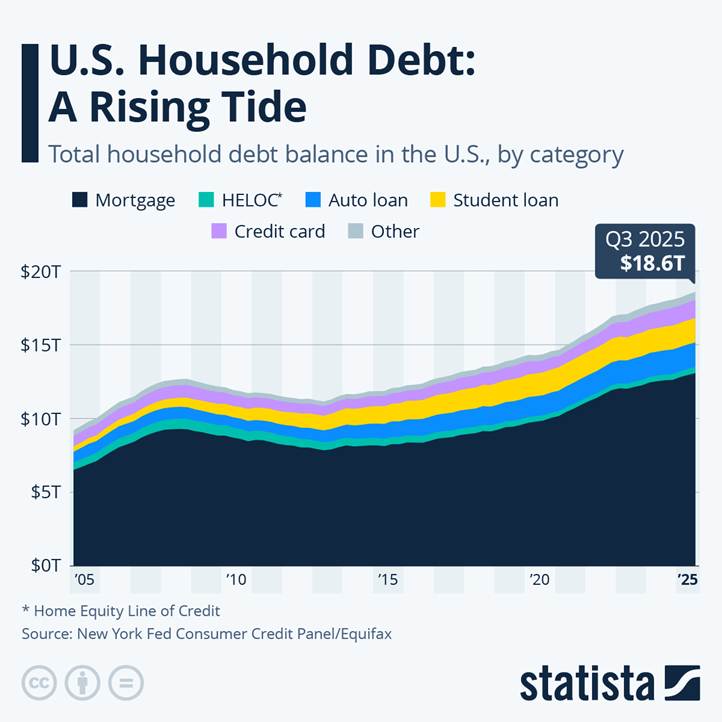
Hard liabilities, soft assets
One of the clearest signs that the US economy has been swallowed by the AI bubble came via soft forward guidance from chipmaker AMD, whose CEO admitted to underestimating just how inflated the AI bubble has become—a bout of honesty for which she was punished with a one-day stock plunge of almost -20%.
Mind you, that one day bout of honesty only served to drag AMD back down to the 2026 performance of the likes of Nvidia (which has also disappointed markets) – both are down by over -6% this year although in AMD’s case that’s around -22.5 below where it peaked in January. As a benchmark, the perennially woeful ARK Innovation exchange traded debacle is down by almost -15% this year and Bitcoin’s utterly fictional price is -23% lower.
One exception is Marvell Technology. We suspect that you’ll be hearing a lot more of this stock (and its psychotic, feckless, reckless CEO Matt Murphy) in the future (in the same way that pets.com came to represent the dot.com bubble burst), especially now that Nvidia has used AI magic finance to buy a stake in Marvell by selling Marvell lots of Nvidia things without Marvell having to actually pay for them (Dire Straits ‘Money for nothing’ should be the leitmotif that plays whenever the 2020s AI bubble is mentioned).[1]
Cropped Circles
Marvell is a market leader in the fantasy world of data centres where everyone is furiously building and committing to build but everything is done on credit or circular financing or asset swapping because nobody actually has any hard cash. Around ¾ of Marvell’s supposed revenues are generated in this space which is why it is so dependent on its suppliers and lenders and broader sources of funding, that its debt levels exceed its fantasy EBITDA. If When the AI bubble bursts, we’d quickly expect this to balloon above the 4-5 x EBITDA level that is indicative of often terminal distress.
Blinking is actually a human trait, Matt……
As Warren Buffett’s late partner, Charlie Munger, often said “the liabilities are always real”.
Reducing that to our level, the MBMG dictum is that “When the revenue stream is nonsense and the liabilities are real, you’re headed towards a major problem.” Or as hedge fund supremo Ray Dalio has pointed out – the wealth versus money mismatch will ultimately burst fantasy bubbles (like the AI circular financing game).[2]
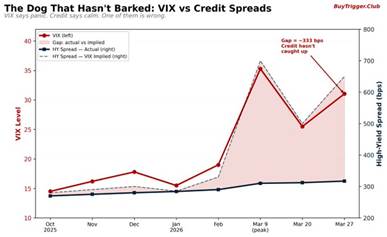
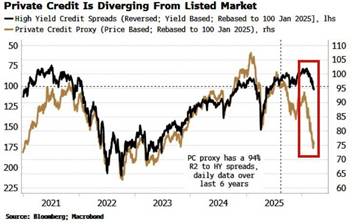
Private credit seems to have started to fall of a cliff.
Equities are suffering fall out.
Yet high yield credit is still holding up one of these things ain’t like the others
Marvell’s double counted, fictitious deal was quicky overshadowed at the very end of March by a record-breaking phony transaction which Open AI’s CFO, Sarah Friar claimed “blows out of the water even the largest IPO that’s ever been done.” [3]
However, the largest IPO that’s ever been done was funded by real money.
whilst Open AI (the provider of ChatGPT) has taken $3 billion from retail investors, alongside the hapless Cathie Wood who has committed to burn more of her long-suffering investors’ hard-earned cash[4], the biggest chunk of the $122 billion that seems to have so excited Sarah Friar is AI-money (just as unreal as Monopoly money but much more dangerous).
$50 billion is being provided by Amazon (except in the small print it’s actually $15 billion which in itself no doubt involves a high degree of circular financial engineering).
$30 billion of dizzyingly circus-ular financing is coming from Nvidia, thereby enabling Nvidia to claim that it sold another $30 billion of AI chips and picked up a free investment in Open AI.
Serial scammers financial engineers Softbank have also dropped in a fake $30 billion
Softbank wannabees including Andreessen Horowitz, Abu Dhabi’s MGX and D.E. Shaw Ventures have made up the rest of the OPM (Other People’s Money).[5]
The bigger the fantasy transaction, the harder the landing when reality kicks in and the greater the certainty that it will kick in, especially as back in the real world, Carmaker Stellantis (Jeep, Ram, Dodge, Chrysler, Fiat, Maserati, Peugeot, Vauxhall, Opel etc) which fell 27% in one day in February ended that month by announcing its first annual loss since the company was formed, while Warren Buffett bowed out of Berkshire Hathaway with a -30% fall in operating earnings in his final quarter and US unemployment surprised most analysts by rising quite sharply (we were shocked – not that unemployment rose but that people hadn’t seen this coming).
Meanwhile the oil price skyrocketed, peaking around 50% higher than before President Don K Trump decided to bring about the opening of the Straits of Hormuz by bringing about the closure of the Straits of Hormuz.[6]
[1] Marvell CEO Matt Murphy’s prominence/notoriety is largely founded on claims in a recent earnings call (edited transcript) “As a result, we expect data center revenue in fiscal 2028 to grow close to 50% year-over-year. Achievement of our forecast would result in 3 straight years of data center revenue growth compounding at well over 40%…..we’ve seen this in a lot of our emerging product areas when we get into them. Once they start doubling, they kinda keep doubling…let’s say, like, this last year doubling this year, you know, maybe over doubling again the year after…We’re in good shape…We’ve grown (custom) business from 0 to $1.5 billion. It’s gonna grow again this year. It’s gonna double the year after….I’m in the AI market…Look at our results that we’re guiding. Look at our outlook for this year. Look at our outlook for next year. Do you see me blinking? You don’t. Yes, we’re in the business. We’re gonna be in the business. Our customers want me to be in this business, and we’re gonna drive a major significant revenue company at Marvell. I’m very fired up on this topic…….if I go back four years, five years, 10 years, this business has been growing at like 35%, 40%, 45% for a very, very long time, and it’s gonna continue to do that. For next year, we’re looking at that growth accelerating, you know, closer to 50% next year.” I guess there are people who want CEOs to talk and think like that but it’s not exactly Warren Buffett is it?
[2] https://www.facebook.com/reel/1454618869604482
[3] The largest IPO ever done was a partial listing of Saudi Aramco for $25.6 billion
[4] The share price of Wood’s ARKK scheme has more than doubled in the past 3 ¼ years, meaning that it is now only around -60% below its peak at the end of 2020. We actually think that it’s good that Wood is committing to invest in Open AI – the final implosion of ARKK will make the capital markets a safer place to be. We just hope that as many victims as possible are able to get out in time. (https://mbmg.substack.com/p/ark-still-sinking )
[5] We’ve previously explained how VC’s ‘Ramp & whomp’ works (or rather doesn’t) – https://mbmg-group.com/everything-ventured-the-inevitable-fall-of-silicon-valley-bank-others/
[6] Maybe the Donald should have learned at least the basics about 1970s oil shock stagflation and how it cost one of the least bad President’s his job – https://www.thoughtco.com/stagflation-in-a-historical-context-1148155
For more information and to speak with our advisors, please contact us at info@mbmg-investment.com or call on +66 2 666 4878.
About the Author:
Paul Gambles is licensed by the Securities and Exchange Commission as both a Securities Fundamental Investment Analyst and an Investment Planner.
Disclaimers:
1. While every effort has been made to ensure that the information contained herein is correct, MBMG Investment Advisory cannot be held responsible for any errors that may occur. The views of the contributors may not necessarily reflect the house view of MBMG Investment Advisory. Views and opinions expressed herein may change with market conditions and should not be used in isolation. 2. Please ensure you understand the nature of the products, return conditions and risks before making any investment decision.
3. An investment is not a deposit; it carries investment risk. Investors are encouraged to make an investment only when investing in such an asset corresponds with their own objectives and only after they have acknowledged all risks and have been informed that the return may be more or less than the initial sum.
13 Comments
Comments are closed.