
Part One of this, at once too cursory but also too long-winded, journey through the history of Iran covered the period from the Mesopotamian era through to the British Empire’s termination of its relationship with its previous agents, the Qajar Dynasty. It ended with the observation that having installed the Pahlavi Dynasty as replacements,
“One of the first challenges facing Reza Shah Pahlavi was the renegotiation of terms under which the previous regime had sold Iranian oil rights to the British.”
Scene set
In the aftermath of WW2, American imperial domination replaced British imperial influence, globally and in the Middle East and North Africa. While this changing of hierarchy became irrefutable during the Suez Crisis of 1956, it had been apparent during the previous decade.[1]
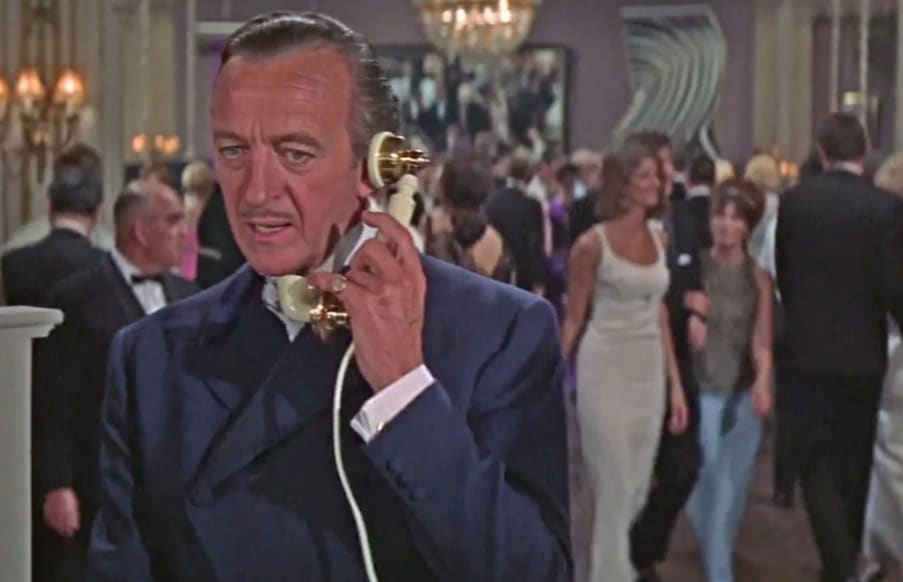
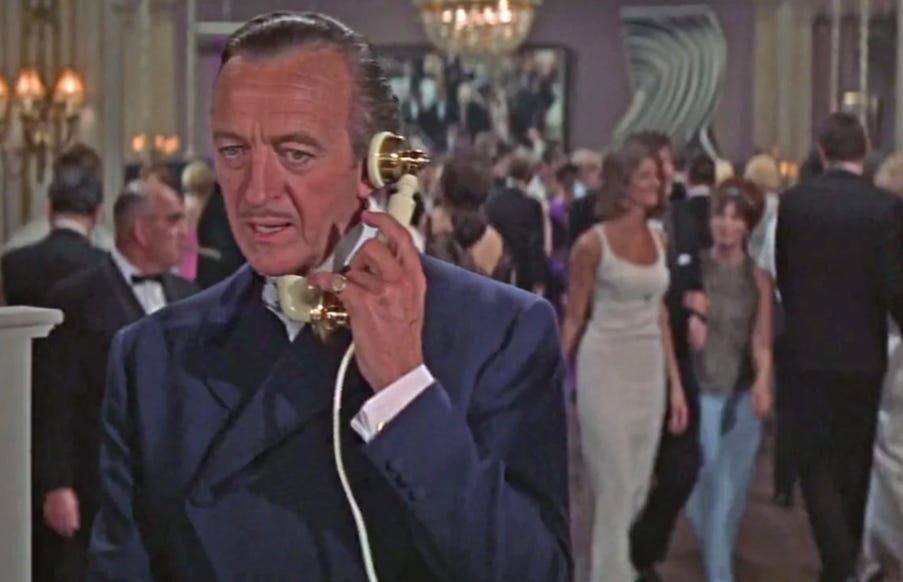
David Niven playing James Bond in the spoof 1967 version of Casino Royale
Reza sharp?
Iran had acquired even greater strategic importance in the twentieth century, when it was discovered to possess significant oil reserves.[2]
The Anglo-Persian Oil Company (APOC) was a British company founded originally by Burmah Oil in 1909 following the discovery of substantial oil fields in Masjed Soleiman. In what was described by First Lord of the Admiralty, Winston Churchill as “a prize from fairyland beyond our wildest dreams”, the British Government soon acquired the majority stake. Churchill’s interest was that APOC production was sufficient to more than meet the energy demands of the British navy.[3]
APOC was to become both the first company to extract petroleum from Iran, and also Britain’s largest overseas asset, and a source of national pride, that thanks to regular updates in Pathe newsreels was known to almost all British cinemagoers and to the minority who owned a TV.[4] In 1935 APOC was renamed the Anglo-Iranian Oil Company (AIOC) following Reza Shah Pahlavi’s edict that the country be known by its formally asked foreign countries to refer to Persia by its endonym.[5]
Construction on the refinery at Abadan began just before WW1.[6]
Striking a nude eel
Upon assuming the leadership of the country, Reza Shah Pahlavi began attempts to renegotiate the terms of the concession that the previous regime had granted, even prior to the incorporation of APOC. British delays and chicanery dragged out negotiations until the 1930s, when Iran was more desperate to achieve a settlement and the world demand for oil was falling sharply during the Great Depression.
A deal was finally struck in 1933:[7]
The concession area was reduced;
Persia was guaranteed a fixed royalty of four shillings per ton of oil plus 20% of the company’s worldwide profits that were actually distributed to shareholders above a certain minimum, subject to a minimum annual payment of £750,000;
The royalties payable for 1931 and 1932 were to be recalculated on the new basis;
‘Persianization’ of the workforce was to be accelerated;
The duration of the concession was extended from 1961 to 1993.
Iranian acceptance of the above final settlement terms was largely driven by Reza Shah Pahlavi. This sacrificed several demands that had been made earlier by other Iranian negotiators, notably the requirement for APOC to move its headquarters to Tehran in order that its affairs could be fully subject to local scrutiny.
Stephen Kinzer notes that the agreement also committed to provide labourers better pay and more chances for advancement and to build schools, hospitals, roads and a telephone system but that APOC/AIOC did not fulfil these promises.
The Empires strike back again
During WW2,a joint Russo-British operation (largely reliant upon troops from Indian regiments) invaded and occupied Iran, securing the oil fields and refineries and opening a secure supply route to the USSR, through which over 4 million tonnes of American Lend-Lease and other materiel were transported.
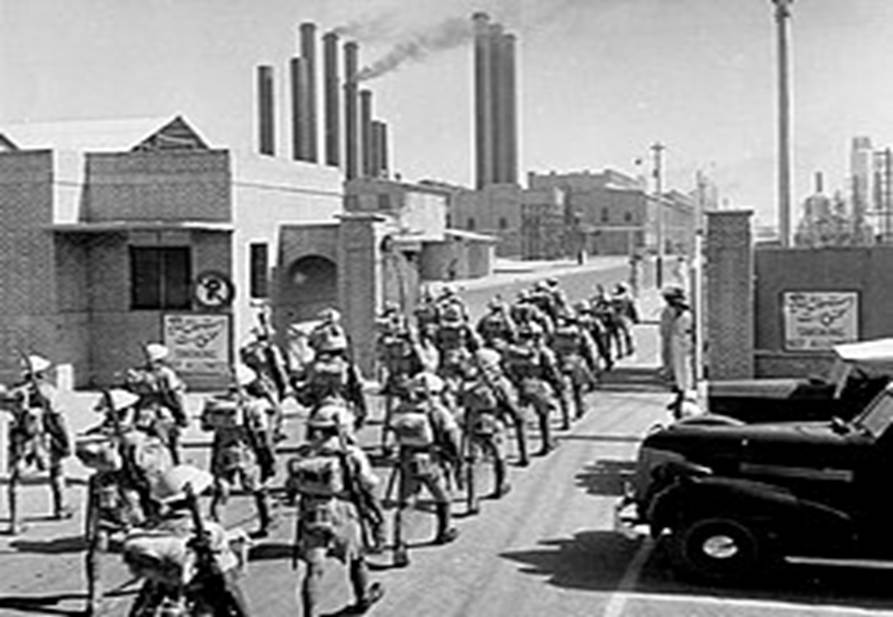
Indian soldiers marching into the Abadan Refinery in 1941
The allies prevailed on Reza Shah Pahlavi to abdicate in favour of his recently graduated son, who would be known as Mohammad Reza Shah and was assumed by the allies to be far more manageable by allied interests.
In the febrile atmosphere following WW2, Abadan became a key rallying cry for Iranian nationalists anxious to escape the de facto shackles of the British Empire, who typified and in many ways dominated the rise in nationalistic sentiment throughout the Middle East.
Playing up, playing up
Although AIOC, aided by Iran’s pro-western post-war government under Prime Minister Ali Razmara, initially resisted nationalist pressure to further revise AIOC’s concession terms still further in Iran’s favour, the British Government, in 1949, offered a placatory “Supplemental oil agreement” which increased the annual guarantee to £4 million, in order to appease anti-western, and specifically anti-British unrest in the country. This entailed further undertakings to train a greater number of Iranians to ultimately run the company.[8] At this time however, there was granted no additional management powers and no right to audit the company books. Iranian discontent was further stirred when in December 1950, it was announced that the American-owned Arabian American Oil Company (ARAMCO) had agreed to share profits with Saudis on a 50-50 basis, something that the British Government immediately dismissed as a possibility for AIOC. Rising nationalist sentiment led to the assassination of Ali Razmara.
“Wages were 50 cents a day. There was no vacation pay, no sick leave, no disability compensation. The workers lived in a shanty town called Kaghazabad, or Paper City, without running water or electricity, … In winter the earth flooded and became a flat, perspiring lake. The mud in town was knee-deep, and … when the rains subsided, clouds of nipping, small-winged flies rose from the stagnant water to fill the nostrils …. Summer was worse. … The heat was torrid … sticky and unrelenting—while the wind and sandstorms shipped off the desert hot as a blower. The dwellings of Kaghazabad, cobbled from rusted oil drums hammered flat, turned into sweltering ovens. … In every crevice hung the foul, sulfurous stench of burning oil …. in Kaghazad there was nothing—not a tea shop, not a bath, not a single tree. The tiled reflecting pool and shaded central square that were part of every Iranian town, … were missing here. The unpaved alleyways were emporiums for rats.” Manucher Farmanfarmaian (Iranian Director of Petroleum).
In March 1951, the Iranian parliament voted to nationalise AIOC (renamed the National Iranian Oil Company, or NIOC). The following month, Mohammed Mossadegh the leader of the main nationalist movement and leading ‘champion’[9] of nationalisation, was elected prime minister; ‘sparking the Abadan Crisis.[10]
This left Mohammad Reza Shah compromised between his reliance on western, mainly British allies, who increasingly resorted to aggressive posturing in relation to Britain’s ‘assets’ in Iran and the recognition that Mossadegh’s nationalism represented vox populi.
In the final part of this trilogy, we look at how this ended – spoiler alert, it hasn’t – it’s continuing before our very eyes.
British.
For more information and to speak with our advisors, please contact us at info@mbmg-investment.com or call on +66 2 666 4878.
About the Author:
Paul Gambles is licensed by the Securities and Exchange Commission as both a Securities Fundamental Investment Analyst and an Investment Planner.
Disclaimers:
1. While every effort has been made to ensure that the information contained herein is correct, MBMG Investment Advisory cannot be held responsible for any errors that may occur. The views of the contributors may not necessarily reflect the house view of MBMG Investment Advisory. Views and opinions expressed herein may change with market conditions and should not be used in isolation.
2. Please ensure you understand the nature of the products, return conditions and risks before making any investment decision.
3. An investment is not a deposit; it carries investment risk. Investors are encouraged to make an investment only when investing in such an asset corresponds with their own objectives and only after they have acknowledged all risks and have been informed that the return may be more or less than the initial sum.
[1] It has even been suggested that the power shift following WW2 is well captured in Ian Fleming’s first James Bond novel, Casino Royale, where bond has to borrow money from the CIA’s Felix Leiter, to defeat the villain, Le Chiffre at the baccarat tables.
[2] With around 140 billion barrels of proven oil reserves and almost 30 trillion cubic meters of proven gas reserves. Iran currently ranks third in terms of oil reserves and second in gas reserves.
[3] With WW1 fast approaching Churchill was keen to upgrade the British naval fleet from a coal-fired to oil powered marine but sought to avoid dependence on the foreign interests that controlled Royal Dutch Shell (a 60% Dutch owned entity at that time) and the Rockefeller-owned Standard Oil Company. Churchill was subsequently employed by APOC to lobby expensively for its interests during the 1920s!
[4] “In the late 1940s and early 1950s some high British officials still believed that Persian petroleum was actually and rightly British petroleum because it had been discovered by the British, developed by British capital, and exploited through British skill and British ingenuity.”-William Louis, an American historian.
[5] In 1954, the company was renamed The British Petroleum Company, and subsequently became BP Plc.
[6] Abadan life can be glimpsed from footage such as- www.youtube.com/watch?v=bEJYVye4Hog although this glosses over conditions for local workers – “Small pox raged, bandits and warlords ruled, water was all but unavailable, and temperatures often soared past 50°C” Stephen Kinzer, All the Shah’s Men
[7] The Prize: The Epic Quest for Oil, Money, and Power Daniel Yergin
[8] Instructive in this context is the following news reel – www.youtube.com/watch?v=6iisvxI8eco
[9] www.en.wikipedia.org/wiki/Anglo-Persian_Oil_Company
[10] Ibid.
7 Comments
Comments are closed.