
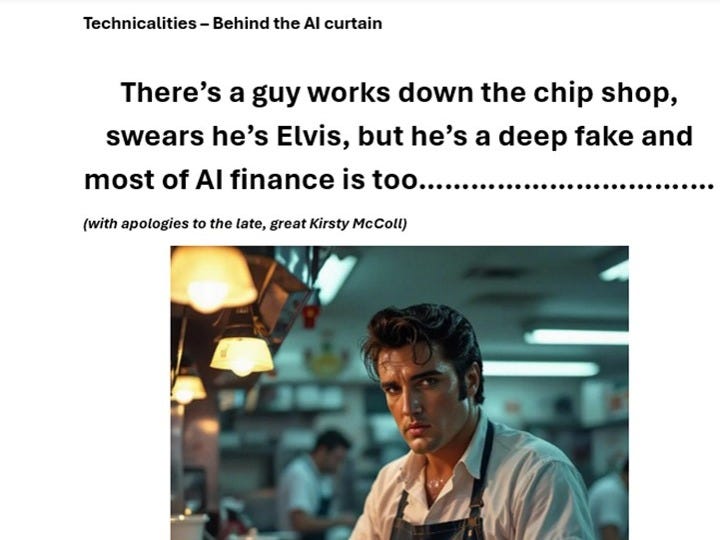
Apologies on behalf of AI.
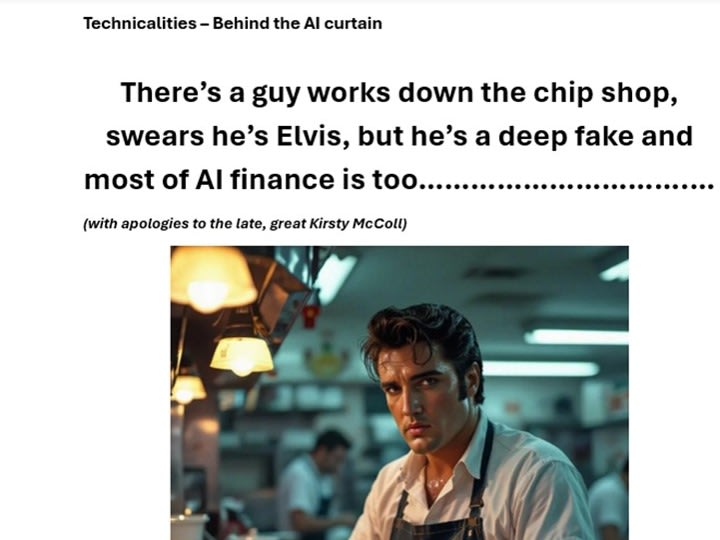
Readers of our most recent post – https://mbmg.substack.com/p/the-48-trillion-question will be aware that we recently wrote a 40-page client outlook focusing on (what else?) AI.
This was broken into 2 parts (as our outlooks tend to be):
Fundamentals
Technicalities
To spare casual readers the pain of ploughing through 40 pages, we then used AI to summarise. We published a (significantly corrected and edited by hominids) version of Gemini’s attempts to precis Fundamentals – https://mbmg.substack.com/p/the-48-trillion-question
For today, we had intended to use ChatGPT’s stab at doing the same with Technicalities. But we can’t. It’s just too awful. Instead, here is a combined summary of both sections written by humans. Apologies for any repetition of https://mbmg.substack.com/p/the-48-trillion-question
An example of how AI’s LLMs lack the basic conceptual understanding of 2 year olds.
MBMG – “Er, AI Bot, in the research that we got you to do on the size of current and future data centres (which you insist on calling centers, even though we’ve set the language to British English) relative to cities and city states, you mention that Manhattan, with an area of 22.7 square miles is bigger than Hong Kong Island, even though Hong Kong Island has an area of over 30 square miles”
AI Bot – “That is correct.”
MBMG “No it isn’t correct. I mean it’s correct that you said it but as a statement of fact it is wrong.”
AI Bot “I have checked. While it is true that Hong Kong Island is larger than Manhattan, Manhattan is in fact bigger than Hong Kong Island.”
MBMG “Uh?”
AI Bot “While it is true that Hong Kong Island is larger than Manhattan, Manhattan is in fact bigger than Hong Kong Island.”
MBMG “Ok, we give up.”
AI Bot “Thank you.”
And yet so-called AI now underpins everything….
Anyway, back to human insights –
This article focuses on the broad financial implications of the AI boom, using the internet bubble as a comparison.
Understanding Data Centres and the Intensifying Data Landscape
The information and communication technology (ICT) landscape has evolved rapidly from the pioneering of Charles Babbage and Alexander Graham Bell, through a history marked by advances, breakthroughs, regulatory shortcomings and economic bubbles to the current era marked by huge data centres.
The Oxford Dictionary defines a data centre as “a large group of networked computer servers typically used by organizations for the remote storage, processing, or distribution of large amounts of data.”
MBMG’s alternative definition of data centres is “huge structures operated by organizations who launch a constant barrage of mainly subliminal data in order to generate financial rewards.”
The volume of data consumed and processed by end-users (i.e. people) is becoming overwhelming:
• In the 16th century, a highly educated individual processed around 74 GB of data over a lifetime.
• By 1986, the average American processed this amount weekly.
• Less than a decade ago, this became a daily figure for many individuals.
• Now we process this volume each day just during our leisure time.
Even more astonishing than the amount processed is the sheer volume of information to which we are exposed. Most data is absorbed subliminally through cognitive shortcuts known as heuristics, rather than actively processed. Our exposure to such data is estimated to be around 250,000 times greater than what we actively process.
While these figures are only estimates, it’s clear that we’re processing more data without improvements in our human cognitive hardware. This highlights how adaptive the human brain is at filtering information to avoid overloading. As data volumes rise, our filtering mechanisms ramp up, leading to the paradox that the more information that we have, the less we might truly understand.
The Scale of Data Centres
Data centres are vast undertakings. Every app you use, every video streamed, and every file saved is supported by data centres – massive facilities essential to the backbone of modern technology, managing everything from cloud storage to national security.
The largest data centre today – China Telecom’s Information Park in Mongolia, which covers almost 11 million square feet – will soon be dwarfed by the campus of the upcoming Meta Hyperion project (comparable in size to Manhattan). Hyperion is projected to need about 120 Gigawatt Hours of electricity per day, which is more than 30 times what China Telecom’s data centre requires, highlighting the growing energy demands in this sector:
The Investment Landscape
Technology giants like Amazon, Google, Meta, Microsoft, and Oracle have made substantial investments in new data centres, funded by circular financing deals and private borrowing. While these investments aim to capture future AI profits, there’s a concern that if the anticipated AI revolution fails to live up to expectations, the economic implications could be severe. The best precedent for this could be the boom of the 1990s when ICT (Information and Communications Technology) businesses invested heavily in anticipation of the internet boom. This of course ultimately led to the tech bubble and dotcom collapse.
The 1990s – seen this movie before?
The Telecommunications Act of 1996 sought to open the American market for communications to increased competition, by removing monopolistic vertical integration (local exchange carriers were only able to offer long-distance and international calls once local competition had been established). In reality, the Act resulted in a highly competitive investment race and significant consolidation in the telecommunications industry which critics argue restricted access for newcomers, contradicting its original intent.
Economic Boom and Subsequent Bubble
Between 1997 and 2000, telecom network providers invested over $100 billion in fibre optic infrastructure to capitalize on expected internet growth. Such frenzied investment activity, predicated on extreme but ultimately vastly overstated demand growth assumptions, contributed to the dot-com bubble and fuelled excessive stock valuations and massive overborrowing. The tech-heavy NASDAQ Composite stock index surged over 600% from 1996 to March 2000 while the blue-chip S&P 500 index exhibited slightly less irrational exuberance, increasing by over 200% in the same period. On the liability side, corporate debt increased by almost 50% during this period and margin debt (borrowing against securities, including dotcom stocks) grew at between 25-30% per year from 1995 to the summer of 1998 and again in 1999.
The Bubble Burst
Early warning signs started to appear in 1999 – an American auction for a 3G spectrum license failed when the winning bidder was unable to pay. This default set the stage for a decline in confidence. Once it became clear that the telecom sector debt burden was unsustainable and the growth assumptions underpinning many dotcoms were unrealistic, businesses collapses ensued. The FCC (the US Federal Communications Commission) Chair admitted that $1 trillion of the debt owed by the sector would likely never be repaid.
In the aftermath of the collapse, the vast majority of new fibre optic capacity remained unused, garnering the nickname “dark fibre.” Meanwhile, The NASDAQ Composite fell nearly 80% and took until 2015 to recover, while the S&P 500 experienced a 47% drop and slow recovery.
A relatively shallow recession followed the bubble’s burst, but unemployment persisted. Policy responses, including low-interest rate policies fostered the conditions that created the GFC (Global Financial Crisis).
Fast Forward: Is there an AI Bubble today?
Major technology companies, referred to as “hyperscalers,” are increasing capital expenditures dramatically. AI-related capital expenditure is forecasted to exceed $600 billion next year. This activity is contributing significantly to global GDP growth; varying estimates talk of it adding $10-20 trillion to global economic activity.
However, some financing strategies within the AI sector are deeply concerning. Partnerships and deals among supplier companies like Nvidia, hyperscalers and numerous AI startups involve complex financial arrangements that essentially bet on future profits without any indication of how debts and liabilities will be repaid. Many metrics today look much frothier than the dotcom era, even when adjusted for inflation to today’s values. Capex is around three times higher and the most speculative aspects (bubble) of that expenditure are more than double the levels of twenty-five years ago:
The capitalisation of the NASDAQ’s component companies is approximately $54 trillion today, around nine times greater than the peak in 2000. Nvidia’s market capitalisation alone recently exceeded $5 trillion. Twenty-five years ago, the NASDAQ collapse wiped out over $4.5 trillion of stock market so-called ‘value’ (which would be almost $9 trillion today, adjusted for inflation). A fall of the same magnitude today among technology-related US stocks would destroy almost $30 trillion from those stocks alone.
For the broader US equity market, a repeat of the Y2K broader collapse would erase around $35 trillion. But the market has fundamentally changed. Technology and AI are no longer mere components of an otherwise much less distorted market. They have become drivers of the whole market, much like TMT drove the NASDAQ at the end of the last millennium:
Conclusion
The current market is characterized by a heightened concentration of risk based on excessive debt held within the technology sector in various forms. As the dynamics continue to evolve, concerns mount over potential market corrections and their impact on the broader economy. The timing and nature of these shifts remain impossible to accurately quantify but a significant decline in technology stock valuations could lead to far greater losses in capital markets than during either the dotcom collapse or the GFC.
Once again, we apologise for repetition.
Sign up for MBMG newsletter from Co-founder & Managing Partner Paul Gambles
MBMG Investment Advisory is licensed by the Securities and Exchange Commission of Thailand as an Investment Advisor under licence number Dor 06-0055-21.
For more information and to speak with our advisor, please contact us at info@mbmg-investment.com or call on +66 2 665 2534.
About the Author:
Paul Gambles is licensed by the SEC as both a Securities Fundamental Investment Analyst and an Investment Planner.
Disclaimers:
1. While every effort has been made to ensure that the information contained herein is correct, MBMG Investment Advisory cannot be held responsible for any errors that may occur. The views of the contributors may not necessarily reflect the house view of MBMG Investment Advisory. Views and opinions expressed herein may change with market conditions and should not be used in isolation.
2. Please ensure you understand the nature of the products, return conditions and risks before making any investment decision.
3. An investment is not a deposit, it carries investment risk. Investors are encouraged to make an investment only when investing in such an asset corresponds with their own objectives and only after they have acknowledge all risks and have been informed that the return may be more or less than the initial sum.