
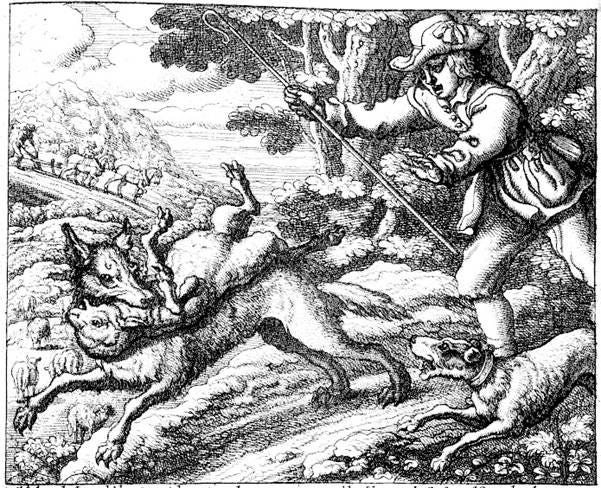
Francis Barlow’s illustration of the fable, 1687
The Aesopica, is a collection of oral-tradition fables, still reread, repeated and re-interpreted today, which are credited to 6th century BC storyteller, Aesop. Originally aimed at adults, these stories were intended as ethical guides exploring religious, social and political themes but are more widely used latterly in children’s education as “fictions that point to the truth.”(https://en.wikipedia.org/wiki/Aesops_Fables.)
Bushy Tale
Fable 210, “The Boy Who Cried Wolf,” gave rise to the English idiom “to cry wolf,” meaning to raise false alarms so often that genuine warnings are later ignored. In the tale, a shepherd boy repeatedly tricks villagers into thinking a wolf is attacking his flock. When a wolf finally appears and the boy cries for help, the villagers dismiss him as a prankster and the wolf devours the sheep. In later English retellings, Victorian retributive justice resulted in the boy himself also being eaten.
Aesop’s moral—commonly rendered as “liars are punished: even when they tell the truth, no one believes them”—echoes Aristotle’s observation that true statements from known liars go untrusted.
False Negative
Modern research across multiple disciplines connects the fable to what we now call alert or alarm fatigue: repeated false alarms reduce responsiveness to real danger. That dynamic has contemporary political resonance. We have long warned that the real danger of Trumpism is not so much ideological but more accidental — incompetence cloaked in arrogance can break systems. Trump may feel that by nominating and Warsh as Fed Chair, Trump will be able to control the policy decisions of the FOMC to a far greater extent, then under the chairmanship of Jerome Powell. However, FOMC policy decisions require a majority vote.[1]
The risk with Kevin Warsh is that having allowed his political leanings to influence his highly vocal policy flip-flops, and having aligned himself so closely to the Trump administrations, his credibility with fellow FOMC members may be fatally compromised. When Warsh most feels the need to warn that aggressive accommodatory policy responses are needed, his dovish cries might result in more hawkish colleagues devouring him.
When the biggest bubble in capital market and economic history finally bursts, the Fed balance sheet, much derided by Warsh, will be the only cushion to break the fall, assuming that a coordinated and well aligned Fed is willing to deploy it.
Warsh’s past false alarms may well result in policy paralysis and inability to act just when it matters most.
“Haven’t you heard it’s a battle of words?”
The poster bearer cried
“Listen, son,” said the man with the gun
“There’s room for you inside” – US & Them, Wright and Waters (Pink Floyd)
[1] All 12 voting members of the FOMC (the 7 Board of Governors members plus the NY Fed President and 4 other regional Fed bank presidents in rotation) each cast one vote on monetary policy decisions. The Chair gets no extra votes, but typically has significant influence as the meeting chair, guiding discussion, helping to build consensus, and summarising prior to any vote. FOMC decisions are made by majority vote. In the event of a tie, there is no tie-breaking vote – any tied motion would simply fail to pass.
6 Comments
Comments are closed.